Not every circle problem involves the whole shape. Sometimes you only need one wedge-shaped piece. This guide explains how to calculate circle sector area, covering both degree and radian approaches with clear examples.
What Is the Area of a Circle Sector?
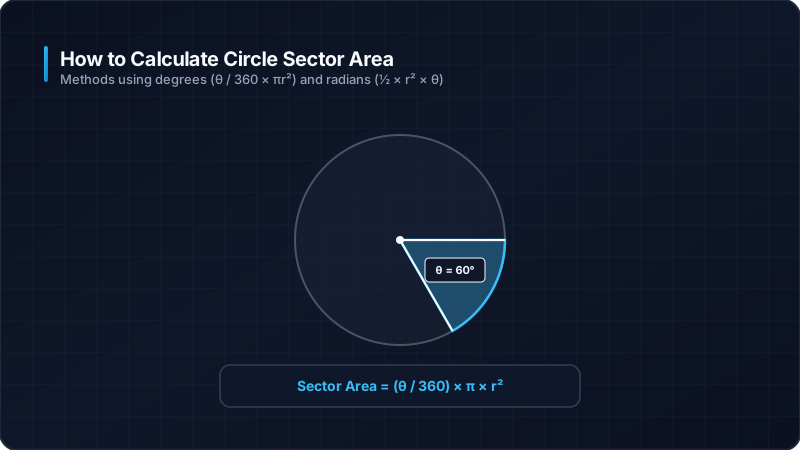
Sector area measures the interior space of one pie-shaped wedge, bounded by two radii and a connecting arc. This circular sector represents a fraction of the total circle area, scaled by its angle.
Understanding what is the area of a circle sector starts with recognizing it as a portion, not the whole shape. This circular region concept sets up every calculation method explored throughout this guide.
How the Central Angle Controls Sector Area
The central angle determines exactly what fraction of the full circle a sector represents. A larger angle produces more sector area; a smaller angle produces less, scaling proportionally and predictably every time.
This how central angle affects area relationship is linear and straightforward. Doubling the angle exactly doubles the resulting sector area, assuming the radius stays constant throughout the entire comparison.
How to Calculate Sector Area in Degrees
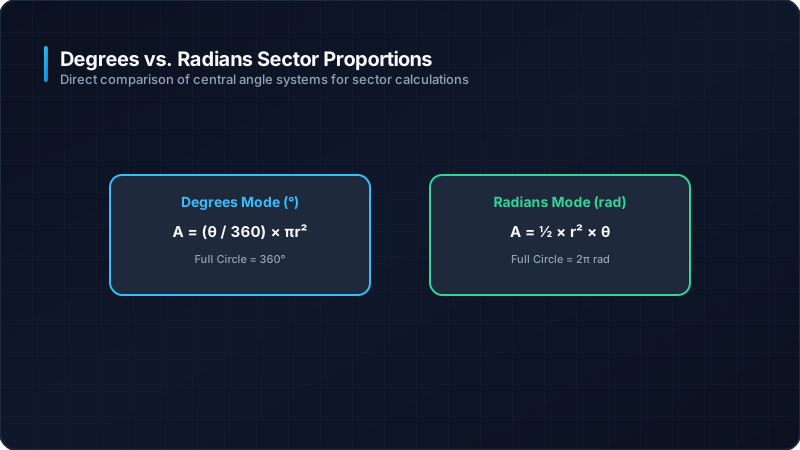
Calculate sector area in degrees using Sector Area = (angle/360) × πr². This formula scales the full circle formula down by whatever fraction the central angle represents out of a complete 360-degree rotation.
For a 60-degree sector with radius 6, calculate π(36) = 113.10 first, then multiply by 60/360 (⅙), giving 18.85 square units. This degree sector area method works for any angle value provided.
How to Calculate Sector Area in Radians
Calculate sector area in radians using Sector Area = (1/2) × r² × angle. This formula skips the 360-degree fraction entirely, since radians already measure angles relative to the circle's natural geometry directly.
For radius 6 and angle 1.047 radians (equivalent to 60 degrees), calculate (1/2)(36)(1.047) = 18.85 square units. This radian sector area result matches the degree-based calculation shown above exactly.
How to Solve Sector Area Examples
| Central Angle | Radius (r) | Sector Area |
|---|---|---|
| 30° sector | 5 | 6.54 |
| 90° sector | 5 | 19.63 |
| 180° sector | 5 | 39.27 |
These sector area examples confirm the formula scales predictably as the central angle increases steadily.
How to Check a Sector Area Answer
Verify your sector area calculator result by dividing it by the full circle area using the same radius. This should return a decimal matching your angle's fraction of 360 degrees exactly.
For the 90-degree example above, 19.63 divided by the full circle area (78.54) equals 0.25, matching 90/360 exactly. This sector area practice check confirms your sector calculation was performed correctly.
How to Calculate Major and Minor Sector Areas
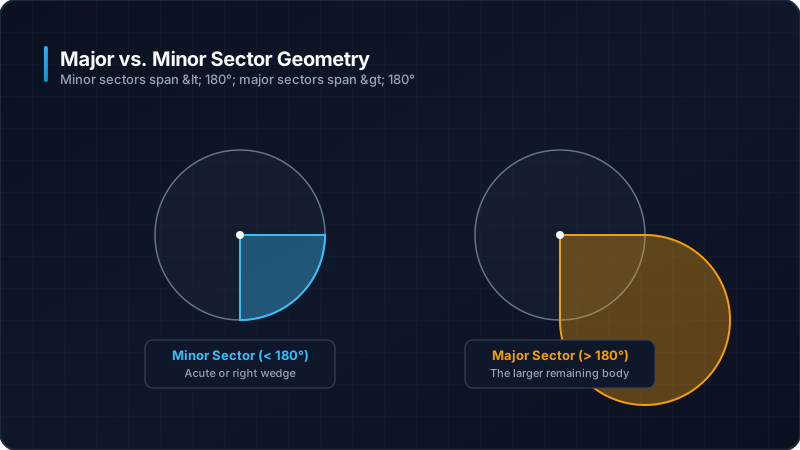
A minor sector spans less than 180 degrees; a major sector spans more. Calculating a major sector calculator value simply means using an angle above 180 degrees in the identical standard formula.
For a 300-degree major sector with radius 4, calculate (300/360) × π(16) = 41.89 square units. This major sector area approach handles large wedges exactly the same way as smaller minor sector pieces.
How to Find Sector Area When Diameter Is Given
If a problem provides diameter sector area information instead of radius, convert diameter to radius first by dividing by two. Then apply the standard sector formula exactly as shown in earlier examples.
For diameter 10 and a 90-degree angle, radius becomes 5. Calculate (90/360) × π(25) = 19.63 square units. This sector area from diameter approach adds just one quick conversion step beforehand.
How Sector Area Relates to the Full Circle
Every sector area is simply a fraction of the complete circle area, determined by the central angle proportion. Recognizing this relationship helps estimate answers quickly, even before running the full calculation.
This circle fraction area thinking builds strong number sense. A 90-degree sector should always be roughly a quarter of the full circle area, offering a useful sector area proportion sanity check.
Conclusion: How to Calculate Circle Sector Area
Calculating sector area relies entirely on scaling the full circle area formula by the central angle fraction. Whether working in degrees or radians, this sector formula guide approach stays consistent and reliable.