
A pizza slice isn't just dinner; it's a perfect geometry lesson. Every cut creates a circle sector, complete with its own sector area and arc length. This guide explains both concepts using familiar, tasty examples.
What Is a Circle Sector?
A circle sector is a pie-shaped wedge cut from a full circle, bounded by two radii and an arc. Think of any pizza slice geometry example; that single slice represents exactly one circular sector.
Every sector takes up a specific fraction of the whole circle, determined entirely by its central angle. Understanding this circle portion concept sets up both sector area and arc length calculations covered next.
How Central Angle Determines Sector Size
The central angle controls exactly how large a sector becomes. A wider angle produces a bigger slice; a narrower angle produces a thinner one. This angle measurement directly scales both area and arc length proportionally.
Measured in degrees or radians, this angle acts like a fraction of the full 360-degree circle. A 90-degree central angle, for example, represents exactly one quarter of the total circular region available.
How to Calculate Sector Area
Sector area formula multiplies the full circle area by the angle fraction. Using degrees: Sector Area = (angle/360) × πr². This sector calculation scales the whole-circle formula down to match your specific wedge.
For a 90-degree sector with radius 4, calculate πr² first (50.27), then multiply by 90/360 (0.25), giving 12.57 square units. This sector area using degrees method works reliably for any central angle value.
How to Find Arc Length From a Central Angle
Arc length formula follows similar logic: Arc Length = (angle/360) × 2πr. This measures the curved outer edge distance, not the interior space, distinguishing it clearly from sector area calculations covered above.
For that same 90-degree sector with radius 4, circumference equals 2π(4) = 25.13. Multiply by 0.25, giving an arc length of 6.28 units. This arc calculation steps process mirrors the sector area method closely.
How Pizza Slices Model Circle Sectors
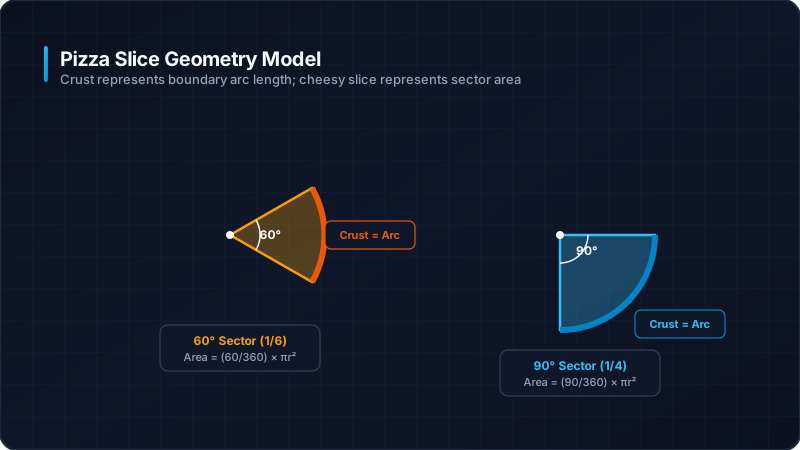
Pizza slice sector examples make abstract geometry tangible. The crust edge represents arc length, while the flat cut edges represent radii. The cheesy interior represents sector area, ready to eat and measure simultaneously.
| Central Angle | Fraction of Circle | Slice Type |
|---|---|---|
| 90° sector | 1/4 (25%) | Quarter slice |
| 60° sector | 1/6 (16.7%) | Standard slice |
| 45° sector | 1/8 (12.5%) | Thin slice |
How Sector Area and Arc Length Are Related
Both values share the same underlying central angle fraction, just applied to different base formulas. One measures circular region space; the other measures circular arc distance along the curved boundary edge.
This sector formula and arc formula relationship means knowing one angle unlocks both calculations simultaneously. Mastering this connection speeds up sector geometry explained problems considerably once the pattern becomes familiar and automatic.
How to Solve Sectors With Angles Greater Than 180 Degrees
A major sector spans more than half the circle, using an angle above 180 degrees. The formulas stay identical; simply plug the larger angle value directly into the same sector area formula shown earlier.
For a 270-degree sector with radius 5, calculate (270/360) × π(25) = 58.90 square units. This circle sector problems approach handles major sector situations just as easily as smaller, more familiar wedge shapes.
How Radians Change Sector and Arc Calculations
Using radians instead of degrees simplifies formulas further. Sector area using radians becomes (1/2) × r² × angle, while arc length using radians becomes r × angle, removing the 360-degree fraction entirely.
For radius 4 and an angle of π/2 radians (equivalent to 90 degrees), sector area equals (1/2)(16)(1.5708) = 12.57, matching the earlier degree-based answer exactly through this radian sector formula approach.
How to Distinguish a Sector From a Segment
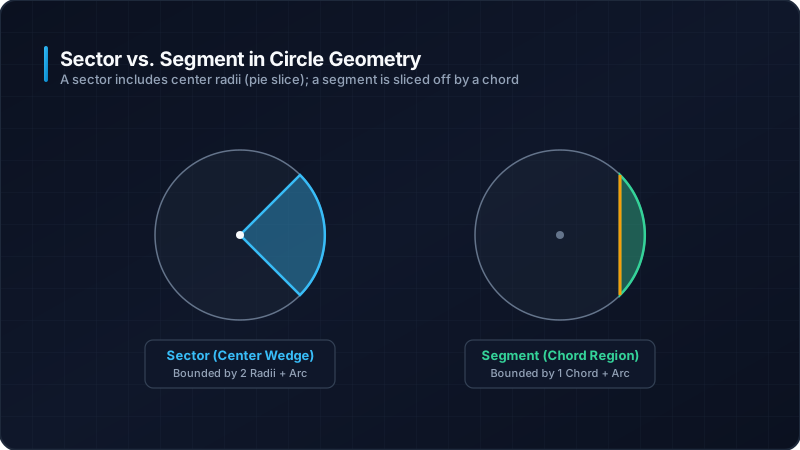
A sector includes the two straight radius lines plus the curved arc, like a full pizza slice. A segment only includes the arc and the straight chord connecting its endpoints, missing the pointed center.
This sector versus segment distinction matters for accurate circular geometry problem-solving. Confusing the two produces incorrect sector calculation results, since a segment's area formula subtracts a triangle from the full sector shape.
Conclusion: How Sector Area and Arc Length Work Together
Sector area and arc length both flow from the same central angle fraction applied differently. Whether measured in degrees or radians, mastering this pizza slice geometry connection makes circle math genuinely intuitive and practical.